Aeration is the most under-done lawn maintenance task in UK gardens. Most domestic lawn owners scarify and feed but never aerate, which means soil compaction quietly undermines everything else they do. The grass weakens, drainage worsens, moss takes over, and feed produces diminishing results because nutrients can’t reach roots that don’t exist.
The good news is that aeration is straightforward once you have the right tool. The bad news is that most “aerators” sold in UK garden centres don’t actually aerate — they compress soil rather than removing it. This guide explains the difference and recommends the specific tools worth buying.
Quick verdict
Best for small lawns: Spear & Jackson Hollow-Tine Hand Aerator — proper hollow-tine extraction at affordable price for small lawn use.
Best roller for medium lawns: Greenkey Hollow-Tine Roller — true hollow-tine action in roller form for larger lawns where hand work is impractical.
Best for occasional serious work: Hire a powered aerator (£40-60 per day from local hire shops) — better than buying for once-a-year use.
Best premium hand tool: Wolf-Garten Hollow-Tine Aerator — German engineering, comfortable to use, lasts decades.
Avoid: Spike-roller “aerators” that don’t extract soil cores. We explain why below.
Aeration that works versus aeration that doesn’t
The fundamental distinction in lawn aerators is whether they remove soil or compress it. This is the most important point in this guide.
Hollow-tine aerators push hollow tubes into the soil and extract plugs (cores) of soil when withdrawn. The result is open holes in the lawn, with extracted cores left on the surface. This genuinely improves soil structure — air and water move into the holes, roots grow into the loosened soil around them, and the cores break down naturally to top-dress the surface.
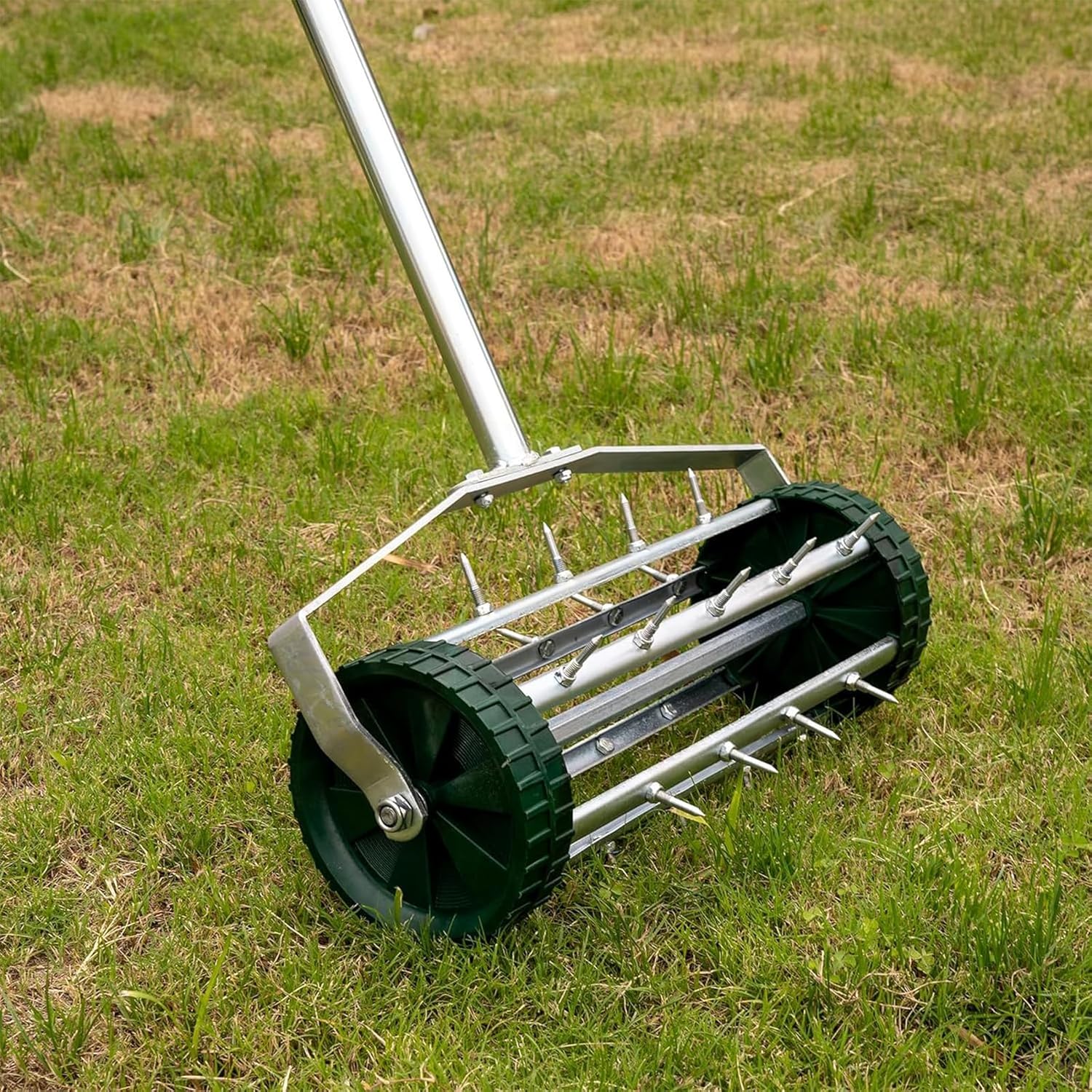
Solid-spike aerators push solid spikes into the soil. The spikes compress soil sideways rather than removing it, often making compaction slightly worse rather than better. Some marginal benefit from creating channels, but the trade-off rarely favours solid spikes for serious aeration work.
Most “rolling aerators” sold in UK garden centres are solid-spike. They’re cheap (£20-40), look like proper aerators, and do almost nothing useful for compacted lawns. Avoid them.
The only legitimate uses for solid-spike aeration: very light maintenance on healthy lawns where compaction isn’t a real problem, or as a precursor to top-dressing where you’re using the spikes to create channels for the dressing to fill. For actual compaction relief, hollow-tine is the only option that works.
How to pick an aerator
Three factors determine which aerator suits your situation.
Lawn size determines whether hand tools are practical. Hand aerating a 50sqm lawn takes 30-45 minutes — manageable. Hand aerating a 200sqm lawn takes 2-3 hours and is genuinely punishing physical work. Above 100sqm, rollers, hired powered machines, or split-session approaches become more sensible.
Frequency of use determines whether to buy or hire. A serious renovation aeration once every 2-3 years justifies hiring a powered aerator (£40-60 per day) rather than buying one (£300-1,000+). Annual maintenance aeration on a small lawn justifies buying a hand tool. Spending £400 on a powered aerator that gets used once a year for ten years works out at £40 per use — exactly the same as hiring.
Soil type affects which tool style works. Heavy clay needs proper hollow-tine extraction; spike rollers do nothing useful on clay. Sandy or loamy soils benefit less dramatically from aeration but still benefit from hollow-tine work. The compaction question matters more than soil type — heavy traffic on any soil produces compaction worth addressing.
A few features that don’t matter as much as marketing suggests:
- “Aerator with collection box.” Cores are valuable as natural top-dressing — you don’t want them collected. Skip products that “tidy up” cores.
- Combined “aerator and scarifier” cassettes on powered machines. The scarifier does scarifying, the aerator does spike-pricking. Neither does proper hollow-tine work. We covered scarifiers in our best electric scarifiers UK guide.
- “Multi-tool” handles. Garden multi-tools rarely excel at any single function. A dedicated aerator works better than an attachment for a different tool.
Spear & Jackson Hollow-Tine Hand Aerator — Best for Small Lawns
For small UK lawns (under 100sqm) where annual hand aeration is realistic, the Spear & Jackson hollow-tine fork is the most practical and affordable proper aerator widely available.
The tool has 3-4 hollow tubes mounted on a steel cross-piece with a wooden T-handle. You step on the cross-piece to drive it into the soil to roughly 10cm depth, then withdraw it pulling cores out. Repeat at 10-15cm intervals across the lawn.
It’s slow work — count on around 20 minutes per 25sqm at reasonable pace — and physically demanding on the lower back. But the results are genuine hollow-tine extraction at a fraction of the cost of powered alternatives.
What works well: actually does what aerators are supposed to do, lasts decades with normal use (the steel construction is genuinely robust), affordable enough that buying makes sense even for occasional use.
What’s awkward: the wooden handle can split if used to lever heavily compacted ground; replace with a steel handle if you’re working on heavy clay. Cores can clog inside the tubes and need clearing periodically with a stick or wire.
Price range: £25-40. Buy if: Small lawn, willing to do the physical work, want proper aeration without major investment.
Greenkey Hollow-Tine Roller — Best Roller
For medium lawns (100-300sqm) where hand work is impractical, the Greenkey hollow-tine roller offers genuine extraction in a roller format.
The tool is a roller drum with hollow tines arranged around its circumference. You walk it across the lawn pushing down on the handle to drive the tines into the soil. The tines extract small cores as the roller rotates, ejecting them through the open ends of the tubes onto the lawn surface.
It’s substantially faster than hand work — a 200sqm lawn aerates in roughly 90 minutes versus 4-5 hours by hand. The trade-off is depth: roller hollow-tine extraction is typically 5-7cm versus 10cm for hand tools, so the soil structure improvement is somewhat shallower.
For maintenance aeration on lawns that are aerated regularly, roller depth is fine. For renovating compacted lawns that haven’t been aerated in years, the deeper hand-tool extraction (or powered hollow-tine machine) produces better results.
What works well: dramatically faster than hand work on medium-large lawns, genuine hollow-tine action rather than fake spike work, sensibly priced for the capability.
What falls short: shallower extraction than dedicated hand tools, requires firm pressure to penetrate properly (the operator’s body weight does most of the work), tines occasionally need clearing with a stick.
Price range: £80-130. Buy if: Medium-to-large lawn, want efficient hollow-tine aeration without hiring or buying expensive powered machines.
Hiring a powered aerator — Best for Occasional Serious Work
For serious renovations, large lawns, or any aeration job over 300sqm, hiring a powered hollow-tine aerator is genuinely the right answer for most UK domestic situations.
UK hire shops (HSS Hire, Brandon Hire, Speedy Hire, plus most local independent hire centres) stock walk-behind hollow-tine aerators at typical day rates of £40-60 plus optional delivery. The machines extract cores at full 10cm depth in long efficient strips, completing a 300sqm lawn in 60-90 minutes versus a full day of hand work.
The advantages are obvious: depth, speed, and lack of physical strain. The disadvantages are less obvious but real: machines are heavy (60-90kg), need a vehicle to collect, require some learning curve to use confidently, and book up quickly in spring and autumn when demand peaks.
Hire is particularly economical for the renovation use case — a one-day hire produces aeration that lasts 2-3 years before another round is needed. Across a decade, hiring twice costs £80-120 total, dramatically less than buying.
What works well: best aeration result available short of professional contractors, no equipment storage burden, no maintenance responsibility.
What’s awkward: requires planning ahead (book 1-2 weeks in advance for spring/autumn dates), transportation logistics, learning to operate the machine on your specific lawn.
Day rate: £40-60 plus £15-30 delivery if needed. Use if: Large lawn, serious renovation, prefer to invest in occasional professional-grade results rather than buying domestic equipment.
Wolf-Garten Hollow-Tine Aerator — Best Premium Hand Tool
If hand aeration is going to be part of your annual routine for years, the Wolf-Garten hollow-tine aerator is the premium hand tool genuinely worth the price difference over budget alternatives.
German construction throughout, ergonomic handle design that reduces back strain compared to T-handle alternatives, and four robust hollow tines that produce cleaner extraction than budget tools. The build quality is the kind that lasts a working lifetime — Wolf-Garten parts and replacement components remain available for tools 20+ years old.
For an occasional user, the Spear & Jackson tool does essentially the same job at half the price. The Wolf-Garten earns its premium for users who’ll use it annually for decades, where the better ergonomics, more reliable extraction, and longer service life compound into real value.
Price range: £55-85. Buy if: You’re committed to annual hand aeration, value tools that last, find the ergonomic difference worthwhile.
Why we don’t recommend most “aerator” products
Walk into any UK garden centre and the aerators section will be dominated by spike-rolling tools at £20-50. These look like aerators, are sold as aerators, but they don’t perform the function aeration is supposed to perform.
Specific products to avoid:
- Solid-spike rolling aerators (any brand). Compress soil rather than removing it.
- “Lawn aerator shoes” (sandals with spikes worn over normal shoes). Marginal benefit at best, often produces uneven aeration patterns.
- Combined “scarifier and aerator” attachments on powered machines. Aerator function on these is solid-spike rather than hollow-tine.
- Cheap hand-held single-tine “aerator” tools. Too slow to be practical on any meaningful area.
If a product description doesn’t explicitly mention “hollow tines” or “core extraction,” assume it’s solid-spike and skip it.
When to aerate
Timing affects how well aeration works.
Best window: autumn (September to mid-October). Soil is still warm enough for grass to recover quickly, autumn rainfall handles watering, and the cool damp conditions through winter let aerated soil settle into improved structure. This is the ideal time for serious renovation aeration.
Acceptable: spring (April to early May). Soil temperatures have warmed enough for active growth, recovery happens within 4-6 weeks. Choose this window for maintenance aeration when autumn was missed.
Avoid: summer. Aerating drought-stressed lawns adds stress without benefit. Wait for autumn.
Avoid: winter. Aerating frozen or waterlogged ground produces no benefit and may damage soil structure further.
For full integration of aeration into the seasonal lawn calendar, see our autumn lawn care UK guide and spring lawn care UK guide.
How often to aerate
The right frequency depends on use and soil.
- Heavily used family lawns or clay soils: Annually. Compaction returns within a year of regular use.
- Moderately used lawns on average soil: Every 2 years. Compaction develops more slowly.
- Lightly used lawns or sandy soils: Every 3 years. Compaction is less of a problem on free-draining soils.
- Renovation context: Once at the start of renovation, then on the maintenance schedule above.
Aerating more frequently than this produces diminishing returns and unnecessary lawn disturbance.
After aeration
Aeration is rarely done in isolation. The standard sequence is:
- Aerate with hollow-tine tool
- Leave cores on lawn surface to break down naturally (or rake off if you prefer immediate tidiness — slight loss of benefit)
- Top-dress with sandy lawn dressing if soil structure needs improvement (5-10kg per square metre, brushed into holes)
- Overseed any thin areas at this point — the aeration holes provide ideal seed-to-soil contact
- Apply appropriate seasonal feed
- Water if rainfall doesn’t arrive within 48-72 hours
This combined sequence — aerate, top-dress, overseed, feed — is the highest-impact lawn maintenance you can do. We’ve covered the full sequence in our complete UK lawn renovation guide.
The structural insight: aeration done properly once a year does more for lawn health than feeding, mowing, and watering combined. Most UK lawns suffer from chronic mild compaction that nobody addresses, and addressing it produces dramatic improvement in everything else.